

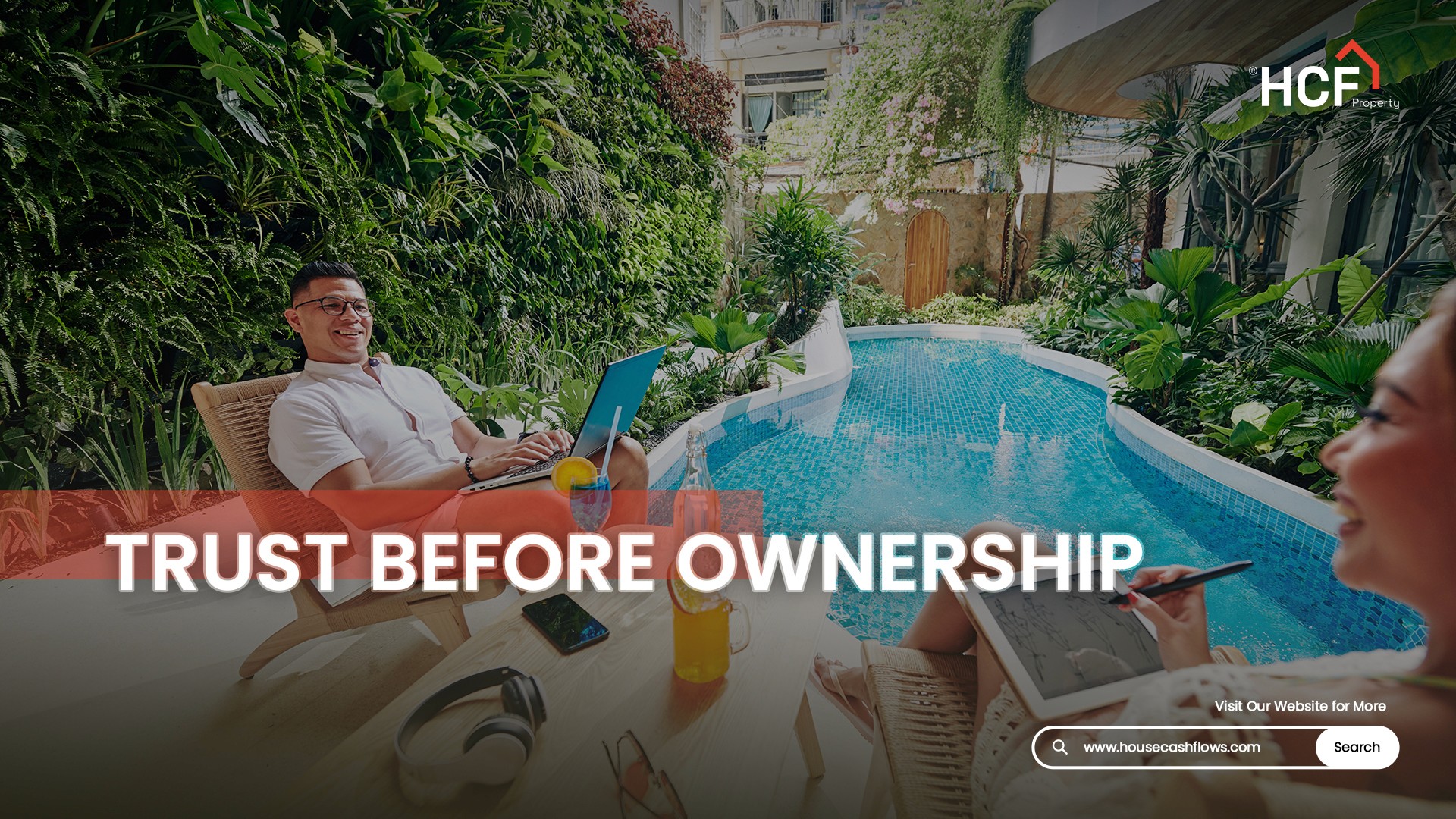
Trust Before Ownership: The New Standard in Real Estate
National Real Estate Day Feature Article
Real estate is changing.
Not in how it looks—
but in how it is understood.
For years, the industry has been driven by visibility. Prime locations, strong visuals, compelling offers. These still matter. But they are no longer enough.
Today, the conversation has shifted.
From speed → to scrutiny
From access → to understanding
From transaction → to trust
Because ownership—real ownership—is no longer just about acquiring a property.
It is about knowing exactly what you are stepping into.
And that is why the future of real estate will belong to developers who can prove one thing clearly:
Trust.
1. From hype to trust: a shift already happening
There was a time when real estate decisions were often driven by momentum.
Markets rising.
Opportunities moving fast.
Buyers acting quickly.
But the global environment today is different.
Investors are more cautious. More informed. More selective. They are navigating a world shaped by economic shifts, geopolitical uncertainty, climate awareness, and changing lifestyle priorities.
This has changed how decisions are made.
People are no longer asking only:
“Is this a good opportunity?”
They are asking:
“Can I trust this opportunity?”
That question goes deeper.
It includes:
the credibility of the developer
the structure behind the project
the long-term viability of the location
the transparency of the process
and the ability to verify everything firsthand
This is not hesitation.
This is maturity.
And it is redefining what real estate must deliver.
2. Why development credibility matters more than ever
A project can look exceptional.
But if the process behind it is unclear, confidence weakens.
In today’s environment, credibility is not built through presentation alone. It is built through consistency, clarity, and structure.
Credibility means:
being able to explain why a location was chosen
demonstrating how decisions are made
showing how risks are assessed
communicating openly throughout the process
and maintaining alignment beyond the point of sale
This is where developers are being re-evaluated.
Not just for what they build—but for how they operate.
At HCF Property, development is not treated as a one-directional process.
It is a shared journey.
Because serious ownership requires more than belief.
It requires understanding.
3. Due diligence: the foundation of serious ownership
Before any ownership decision, there must be due diligence.
Not as a final checklist—but as a starting point.
Due diligence is the process of asking the right questions before committing.
It looks at:
land suitability
environmental conditions
access and infrastructure
local context
legal and structural clarity
long-term development viability
In emerging destinations especially, this becomes critical.
The opportunity may be strong.
But so is the responsibility to understand it properly.
At HCF Property, due diligence is embedded into how developments are approached.
This includes evaluating:
how the land behaves over time
how the destination is evolving
how tourism and accessibility are developing
how the environment supports long-term use
how the project fits within a broader ecosystem
This process is not rushed.
Because a decision that lasts should be built on clarity.
4. Governance: where trust becomes visible
Trust is often spoken about.
But governance is where it becomes real.
Governance is not a concept. It is a system.
It is how a development is:
structured
documented
managed
communicated
and held accountable
For investors, governance answers the questions that matter most:
How transparent is the process?
How are decisions recorded and shared?
How is compliance handled?
Who is responsible for what?
In a market where uncertainty exists, governance creates stability.
It ensures that ownership is not only based on expectation—but supported by process.
At HCF Property, governance is not treated as an afterthought.
It is built into the development framework.
Because confidence does not come from what is promised.
It comes from what is structured.
5. Risk awareness: understanding before committing
Every real estate decision carries some level of risk.
The difference is not in whether risk exists—
but in how it is understood and managed.
Today’s investors are more aware of:
environmental risks
climate considerations
location resilience
market cycles
operational uncertainties
This awareness is not negative.
It is necessary.
Responsible development does not ignore risk.
It acknowledges it, evaluates it, and communicates it.
At HCF Property, risk awareness is part of the conversation.
It includes understanding:
the physical environment
the long-term suitability of the land
the surrounding development context
how the destination may evolve over time
Because trust is not built by avoiding difficult questions.
It is built by addressing them clearly.
6. Why investors should visit every location
There is a limit to what can be understood remotely.
Images can inspire.
Videos can attract.
Presentations can inform.
But they cannot replace presence.
This is why one of the most important principles at HCF Property is simple:
Investors should visit each location.
Because the decision is not just about the project.
It is about the place.
A visit allows the investor to:
experience the environment
understand the scale
observe the surroundings
assess access and infrastructure
connect with the location beyond visuals
It turns information into understanding.
And understanding into confidence.
This is not an additional step.
It is a critical part of the process.
Because ownership should not be decided from a distance alone.
7. The Legacy Program: trust through experience
To support this approach, HCF Property created the Legacy Program.
Not as a marketing experience.
But as a verification journey.
Through the Legacy Program, investors are invited to:
visit the destination
engage with the team
walk through the site
understand the development in context
ask questions openly
evaluate the opportunity firsthand
This creates a different kind of confidence.
Not based on assumption.
But based on experience.
It allows the investor to move from:
“I like this opportunity”
to:
“I understand this opportunity.”
That shift is where trust is built.
8. Equity Estate: structure as clarity
Ownership is evolving.
Not every investor approaches it the same way.
Some want full ownership.
Others want structured participation.
This is where Equity Estate becomes relevant.
Equity Estate offers a more structured pathway into ownership—designed for clarity, flexibility, and alignment with long-term goals.
But its value is not in accessibility alone.
Its value is in how it is positioned.
Not as a shortcut.
But as a structured option within a guided process.
At HCF Property, Equity Estate is part of a larger system:
understand the destination
evaluate the process
experience the location
review the structure
then decide
Because ownership should not be simplified to speed.
It should be built on understanding.
9. The future of real estate: relationship-led development
The real estate landscape is becoming more selective.
Investors are no longer only looking for opportunity.
They are looking for alignment.
Alignment with:
their values
their long-term plans
their lifestyle
their understanding of risk
and their trust in the developer
This is why relationship-led development is becoming more important.
A relationship does not end at a transaction.
It continues through:
communication
transparency
guidance
shared understanding
This is where HCF Property positions itself differently.
Not only as a developer of destinations.
But as a developer of trust.
Closing: trust before ownership
On this National Real Estate Day, one thing is becoming clear:
Ownership is changing.
It is no longer about how quickly a decision is made.
It is about how well it is understood.
Before ownership, there must be:
due diligence
governance
transparency
risk awareness
firsthand experience
and relationship
Because the best decisions are not rushed.
They are built.
HCF Property is not just a developer. It is a gateway to intentional ownership.
CTA
Request private access to understand more.
Author
Romer Tasedo
Brand Lead Manager, HCF PROPERTY